
J.P. Morgan Secret
This series is a story for general readers. It is not financial, investment, or legal advice. Lottery odds do not change, and old market stories are not a promise about what happens next.
A seven-part series

Prologue: The Discovery That Changed Everything
The rain hammered against the windows of the Morgan Library on that peculiar Tuesday evening in October 2019. Sarah Chen, a junior archivist tasked with digitizing old acquisition records, wasn't supposed to be in the restricted vault. But a misfiled key card had granted her access to a section that hadn't been catalogd since 1913.
What she found there would challenge everything she believed about how financial markets really work.
Tucked between two leather-bound volumes of correspondence was a slim notebook, its pages yellowed with age. The handwriting was unmistakably J.P. Morgan's—she'd spent months studying it. But these weren't business notes or personal letters. They were calculations. Strange calculations with symbols she didn't recognize, dates circled in red ink, and beside them, market predictions with percentage probabilities.
The final entry was dated March 30, 1913. The day before Morgan died.
Sarah's hands trembled as she photographed each page with her phone. She knew she was holding something extraordinary—evidence that one of history's greatest financiers had been using methods that conventional history had completely overlooked. Methods that, according to the notebook's meticulous records, had predicted every major market move from 1895 to 1913 with an accuracy that should have been impossible.
But the most shocking discovery came on the last page. There, in Morgan's careful script, was a note: "The system works. Adams was right. The ancient methods, when properly calculated, reveal what others cannot see. I leave this record for those wise enough to seek it, brave enough to use it, and discreet enough to protect it."
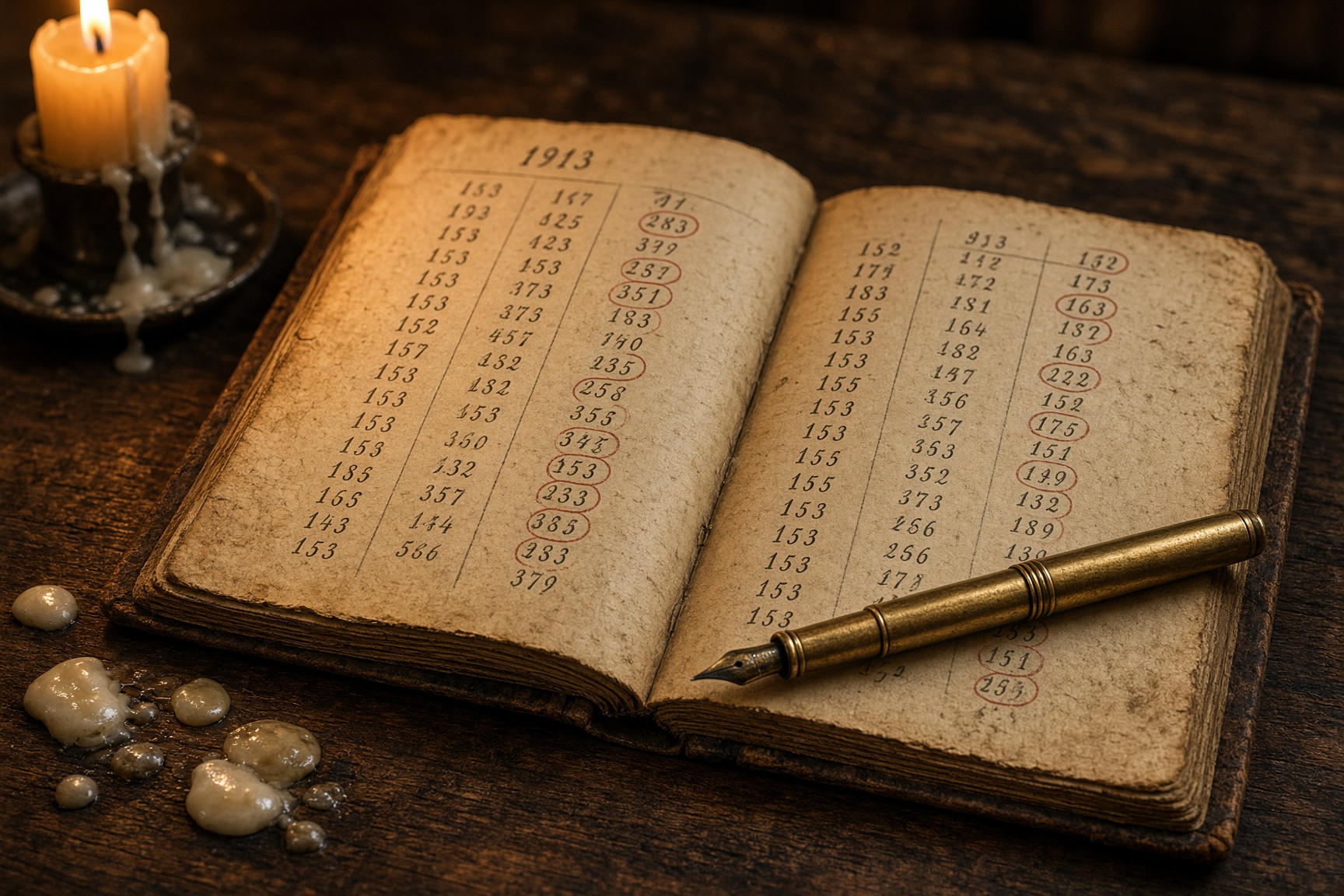
Sarah closed the notebook, her mind racing. She had two choices: report the discovery and watch it disappear into academic obscurity, or study it herself and discover what Morgan had really known.
She chose to study it.
What she learned over the next five years would transform her from a $42,000-a-year archivist into someone managing a nine-figure portfolio. But more importantly, it would reveal a hidden history of financial success that connects ancient Babylon to Wall Street, links medieval merchants to modern hedge funds, and exposes the real reason why some traders consistently outperform the market while others, using the exact same publicly available information, consistently fail.
This is that story. But more than that, it's an invitation. Because what Sarah discovered isn't just historical curiosity. It's a living system, still used today by a select group of traders who understand that the market isn't just numbers and charts. It's patterns. Ancient patterns. Patterns that repeat with mathematical precision. Patterns that, once you learn to see them, become impossible to ignore.
As you read this, you might find yourself wondering if such a thing could really be true. That's natural. Sarah wondered the same thing. Right up until she made her first million using Morgan's methods.
But I'm getting ahead of myself. To understand how this system works—and why it's been kept secret for so long—we need to go back to the beginning. Not to Morgan's era, but much further. To ancient Babylon, where priests in ziggurat temples first discovered that the movements of celestial bodies corresponded with earthly events in ways that could be calculated, predicted, and profited from.
They called it the "wisdom of the heavens." Today, we might call it something else. But whatever name we give it, the results speak for themselves.