
Your Own Timing

Chapter 8: Your Personal Trading Rhythm
One of Morgan's most intriguing discoveries was that individuals have personal trading cycles based on their birth date. This isn't about sun signs or newspaper horoscopes. It's about mathematical cycles that begin at birth and continue throughout life.
Think of it like biorhythms, but far more sophisticated. Just as your body has physical, emotional, and intellectual cycles, you have financial cycles—periods when your judgment is sharp and periods when it's clouded, times when risks pay off and times when they don't.
Morgan tracked his own cycles meticulously. He found that his best trades clustered around specific days each month, while his worst trades also followed a pattern. By simply avoiding trading on his "negative" days, he improved his success rate by 20%.
Sarah tested this concept on herself and her students. The results were remarkable. Every trader had clear patterns. Some were subtle, others dramatic, but all were statistically significant.
The calculation is complex, involving multiple cycles of different lengths:
Personal Day Cycle: Based on the moon's position relative to your birth moon
Personal Month Cycle: Based on the sun's position relative to your birth sun
Personal Year Cycle: Based on planetary returns to birth positions
When these cycles align positively, you're in what Morgan called "the zone"—a period of enhanced intuition and decision-making. When they clash, you're in "turbulence"—prone to errors and misreading markets.
Marcus, the formerly struggling day trader, found this aspect of the system transformative. "I used to trade every day, thinking more activity meant more opportunity. But I was actually sabotaging myself. My worst losses all came during my turbulent periods. Now I trade maybe 10 days a month—only during my positive cycles—and make more money with less stress."
This personal optimization extends beyond just when to trade. The system also reveals:
Which types of trades suit your natural temperament
Which market sectors resonate with your energy
Which timeframes align with your rhythms
Which strategies complement your strengths
Jennifer discovered she had a natural affinity for technology stocks during certain planetary periods. "It was uncanny. During my 'tech phases,' I could almost feel what those stocks were going to do. I'd look at a chart and instantly know if it was a buy or not. Outside those phases, tech stocks were just noise to me."
She restructured her entire trading approach around these insights. Instead of trying to trade everything all the time, she focused on specific sectors during specific periods. Her returns doubled while her stress halved.
This personalization is why the system can't be fully automated. While the astronomical calculations are objective, their interaction with individual psychology is unique. Two traders might see the same planetary configuration, but based on their personal cycles, one should buy while the other should wait.
It's this individual element that makes the system both powerful and protected. Even if everyone knew about it, they couldn't all trade it the same way. The edge remains.
Chapter 9: The Wealth Frequency
There's a concept in the ancient texts that Morgan found particularly fascinating: the idea of "wealth frequency" or what the Babylonians called "the rhythm of abundance."
According to this principle, wealth isn't just about having money—it's about being synchronized with the flow of money. When you're on the right frequency, opportunities appear, decisions clarify, and success seems effortless. When you're off frequency, everything is a struggle.
Modern neuroscience supports this idea. Researchers have found that successful traders show distinct brainwave patterns when making profitable decisions. These patterns can be enhanced through practice and training. The ancient system provides a roadmap for this training.
The first step is awareness. Most people go through life unconscious of the cycles affecting them. They attribute success to skill and failure to bad luck, never recognizing the patterns underlying both.
As you read this, you might be starting to recall your own experiences with these cycles. Perhaps you're remembering a period when everything you touched turned to gold, when you couldn't make a wrong decision if you tried. Or maybe you're thinking of a time when nothing worked, when even your best ideas failed.
These weren't random fluctuations. They were cycles. And once you understand your cycles, you can ride them instead of being ridden by them.
The second step is alignment. This means scheduling your important financial decisions for optimal times. It means being aggressive during your power periods and conservative during vulnerable times. It means working with your natural rhythm instead of against it.
Sarah learned this lesson the hard way. Early in her journey with the system, she identified a fantastic opportunity in biotech stocks. All the cycles aligned perfectly—except her personal ones. She was entering a turbulent period. But the opportunity seemed too good to pass up, so she took the trade anyway.
The trade failed spectacularly. Not because the analysis was wrong—biotech stocks did rally, exactly as predicted. But Sarah's execution was terrible. She entered too early, used too much leverage, and panicked out at the worst possible moment. The opportunity was real, but she wasn't aligned with it.
"That loss taught me humility," Sarah reflected. "The market doesn't care how smart you are or how good your analysis is. If you're not in sync with your own rhythms, you'll find a way to fail. Conversely, when you are in sync, even mediocre opportunities can become profitable."
The third step is amplification. Once you're aware of your cycles and aligned with them, you can begin to amplify their positive effects. This involves both practical techniques and psychological practices.
On the practical side, Morgan developed specific rituals for important trading days. He would arrive at his office at precise times, sit in a particular chair, and even wear certain clothes. These weren't superstitions—they were anchors, physical actions that triggered optimal mental states.
Modern sports psychology recognizes this principle. Elite athletes use pre-performance routines to enter "the zone." The ancient system provides traders with similar tools, but tailored to financial performance rather than physical achievement.
On the psychological side, the system includes meditation and visualization techniques adapted from Babylonian temple practices. These aren't mystical exercises—they're practical methods for synchronizing your consciousness with market rhythms.
One technique, which Morgan called "market breathing," involves synchronizing your breath with price movements on a chart. Inhale as prices rise, exhale as they fall. Do this for just five minutes before trading, and you'll find your intuition sharpened, your timing improved.
Another technique involves visualizing successful trades during optimal planetary hours. The combination of mental rehearsal and cosmic timing creates what modern psychologists call "super-learning states"—periods of accelerated skill acquisition.
These practices might sound strange, but they work. Every student who's applied them consistently has reported improved performance. Not because the practices are magical, but because they optimize the trader's psychological state for market engagement.
Chapter 10: The Hidden Architecture of Price
One of the most profound insights in Morgan's notebook concerns the structure of price movements themselves. According to the ancient system, prices don't move randomly—they follow geometric patterns that reflect universal mathematical principles.
This isn't the simple geometry of triangles and head-and-shoulders patterns that technical analysts use. This is sacred geometry—the mathematical relationships that appear throughout nature, from the spiral of galaxies to the arrangement of flower petals.
The key ratio is phi (φ), also known as the golden ratio: 1.618… This number appears everywhere in nature and, as Morgan discovered, in markets as well.
Major price moves tend to extend 1.618 times previous moves. Retracements often stop at 0.618 (the inverse of phi) of the prior advance. Time cycles often relate by factors of phi. Even volatility follows phi-based patterns.
But here's where it gets interesting: these phi relationships are strongest at specific planetary configurations. It's as if the cosmic geometry amplifies the market geometry, creating moments of mathematical harmony when prices must move in predictable ways.
Sarah discovered she could identify these "harmonic points" in advance. When price, time, and planetary geometry all aligned at phi relationships, major moves were almost inevitable.
One of her most spectacular trades came from recognizing such an alignment. In August 2020, she noticed that:
Tesla's stock price was exactly 1.618 times its March low
The time from the March low was 161.8 trading days
Mars was forming a golden ratio angle to its position at the March low
The triple phi alignment was too perfect to ignore. She bought Tesla calls.
Three weeks later, Tesla announced its stock split and inclusion in the S&P 500. The stock soared 50%. The calls returned 1,200%.
"It wasn't luck," Sarah insisted. "The geometry told me something big was coming. I didn't know what—stock split, S&P inclusion, whatever—but I knew the harmonic alignment would produce a major move."
This geometric approach extends beyond individual stocks. Entire markets follow geometric patterns that the ancient system maps precisely.
The Dow Jones Industrial Average, for instance, follows a long-term spiral pattern that Morgan identified in 1902. He predicted that the Dow would reach 100 by 1906 (it did), 400 by 1928 (it hit 381), and—most remarkably—40,000 by 2025.
That last prediction seemed absurd for decades. The Dow didn't even reach 1,000 until 1972. But as I write this in late 2024, with the Dow near 40,000, Morgan's geometric projection has proved remarkably accurate.
The geometry also reveals market structure that's invisible to conventional analysis. What looks like random volatility actually follows precise mathematical relationships. Support and resistance levels that seem arbitrary actually align with geometric points calculated from planetary positions.
W.D. Gann understood this deeply. His famous "Square of Nine" calculator was actually a device for converting planetary positions into price levels. When you know the astronomical geometry, you can calculate exactly where prices will find support or resistance.
This isn't theoretical. Traders using these geometric methods consistently identify turning points that conventional technical analysis misses. They enter trends earlier, exit closer to tops, and avoid the false signals that plague standard indicators.
But the geometry goes even deeper. Morgan's notebook contains references to "price harmonics"—the idea that prices vibrate like musical notes, creating harmonies and discords that trained ears can hear.
This might sound fanciful, but consider: many successful traders report "feeling" when a market is about to turn. They can't explain it logically, but they sense something changing. What if what they're sensing is a shift in the harmonic structure of price—a discord resolving to harmony or vice versa?
Sarah learned to recognize these harmonic shifts. She would display price charts while listening to music, training her brain to associate visual patterns with auditory rhythms. After months of practice, she could "hear" when a trend was exhausting, when a breakout was genuine, when a reversal was imminent.
"It's like learning a new language," she explained. "At first, it's just noise. But gradually, patterns emerge. You start recognizing phrases, understanding grammar. Eventually, you're fluent. The market speaks to you, and you understand what it's saying."
Chapter 11: The Sector Rotation Secret
One of the most practical applications of the ancient system is predicting sector rotation—knowing which industries will outperform and when.
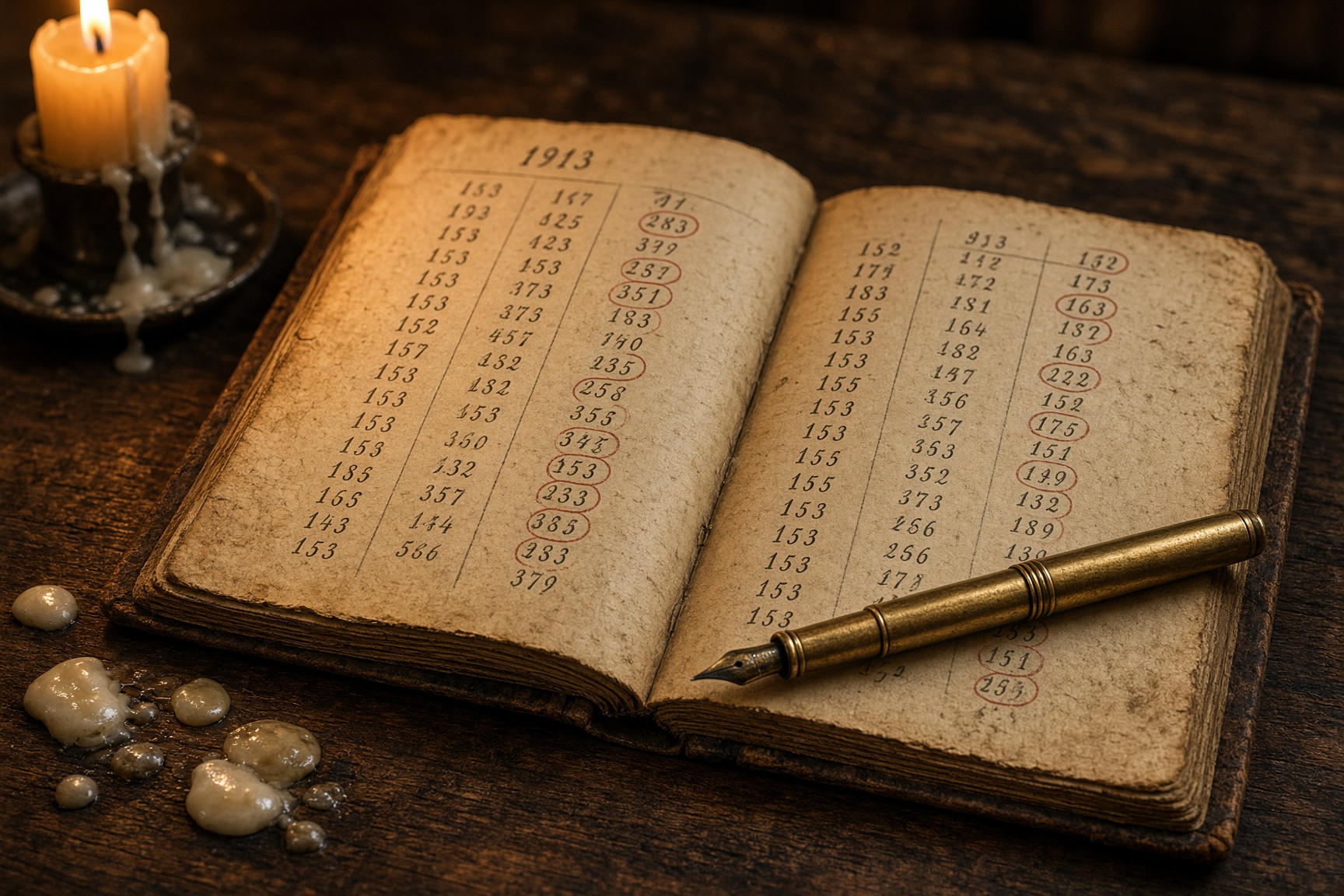
Morgan's notebook contains detailed tables showing how different planetary configurations favor different business sectors. The correlations are striking:
Technology thrives during Uranus aspects (innovation, disruption)
Banking strengthens during Saturn aspects (structure, consolidation)
Energy surges during Mars aspects (power, aggression)
Consumer goods flourish during Venus aspects (pleasure, spending)
Healthcare advances during Neptune aspects (healing, compassion)
Transportation accelerates during Mercury aspects (movement, communication)
These aren't vague associations. They're specific, measurable correlations that have held for over a century.
During the dot-com boom of the late 1990s, Uranus was in its own sign of Aquarius—the strongest possible position for technology innovation. When Uranus left Aquarius in 2003, the tech bubble had fully deflated.
During the financial crisis of 2008, Saturn opposed Uranus—structure versus disruption, old versus new. Banks (Saturn) collapsed while technology companies (Uranus) like Apple and Google emerged stronger.
During the pandemic of 2020, Neptune in Pisces (its own sign) brought healthcare to the forefront. Pharmaceutical and biotech stocks soared while Neptune's influence peaked.
These patterns repeat reliably enough to build investment strategies around them. Sarah developed what she called "sector surfing"—rotating her portfolio to align with planetary favorability.
The results spoke for themselves. While buy-and-hold investors struggled with volatility, Sarah smoothly moved from winning sector to winning sector. She was in technology before it rallied, out before it corrected. She bought energy stocks before oil spiked, sold before it crashed.
"It's not about predicting exact prices," she explained. "It's about being in the right place at the right time. The ancient system tells you which sectors have cosmic wind at their backs. You just position your sails accordingly."
Marcus applied this approach to his day trading. Instead of trying to trade everything, he focused only on sectors in favorable planetary periods. His win rate improved dramatically.
"I used to waste so much energy fighting stocks that wouldn't move," he said. "Now I only trade sectors with cosmic momentum. It's like the difference between swimming upstream and floating with the current."
The sector rotation system also reveals longer-term themes. Morgan predicted in 1910 that the automobile industry would dominate the American economy for "seven cycles of Saturn"—approximately 200 years. We're now in the final Saturn cycle of that prediction, and indeed, the automotive industry is transforming with electric vehicles and autonomous driving.
Morgan also predicted that "the age of air" would begin in 2020, when Jupiter and Saturn conjoined in Aquarius, an air sign. This would mark a 200-year period dominated by information, communication, and intellectual property rather than physical goods.
Right on schedule, 2020 brought the pandemic that accelerated digital transformation by a decade. Remote work, cryptocurrency, artificial intelligence, virtual reality—all "air" technologies—suddenly dominated. The physical economy became secondary to the digital economy.
Understanding these long-term cycles provides enormous advantage. While others react to changes, you can position yourself years in advance. You can build careers in rising sectors and exit declining ones before the crowd realizes what's happening.